How to recognize, mature and live them out
Start readingFor many years, some of my strongest traits were treated as flaws. My intensity seemed like too much. My difficulty in giving up seemed like stubbornness. My sensitivity seemed like fragility. My high standards for myself seemed like perfectionism.
Sometimes it was I who called these things a problem. Other times it was the people around me. And I spent far too long trying to shrink what I would later understand was strength.
Maybe you know this feeling. Throughout life, many of us receive labels: anxious, difficult, demanding, intense, too sensitive, controlling, worries too much. Some of these labels came from outside. Others we stuck on ourselves. And we came to believe we needed to fix ourselves, when perhaps we only needed to understand ourselves.
I write this study as someone sitting beside you to talk, not as someone who has all the answers. I am a woman, a mother, a wife, and I spent thirty years in the corporate world learning, often the hard way, to recognize strengths no one had taught me to name. Some of those discoveries came late. Perhaps some will reach you sooner than they reached me, and that is why I decided to share them.
This study is born of a question that changed the way I look at my own history: what if some of the traits we spend our lives trying to shrink are strengths that were never given a name?
Naming a strength is not creating a new standard for women. It is learning to discern what is strength, what became distortion through pain, what was exploited to exhaustion, and what still needs to mature before God.

In the first two studies on this blog, we walked through the meaning of ezer kenegdo, the expression found in Genesis 2:18. We saw that the woman does not appear in creation as a secondary presence or an inferior helper. She is presented as a corresponding help, a strength that stands before, face to face, created by God to take part in the answer to the first "it is not good" of the biblical narrative, human loneliness.
We also saw how the fall distorted that design, and how Jesus, throughout the Gospels, gave women back their voice, dignity, belonging, learning and mission. I do not want to retrace that whole path here. If you have not yet read those studies, they are on the blog and help lay the foundation. In this third step, I want to move to another question: how does this strength show up in real life?
I need to be honest about the origin of this model, because it matters. The seven strengths that give this study its name do not appear in the Bible as a ready, numbered list. They were born of a personal study I carried out while examining Ezer Kenegdo. I compared the biblical meaning of the expression, the stories of women in the Bible who inspire me, the patterns I recognized in those narratives, and the experiences I lived as a woman, mother, wife, executive, leader and person of faith.
Reviewing my own history in the light of Scripture, I began to recognize dimensions that had been present in different seasons of my life, strengths I had exercised for years without knowing how to name them. Part of that work was to separate what was strength from what was wound, fear or distortion. The same intensity that helped me sustain hard processes could also turn into control when I was afraid. The same sensitivity that helped me perceive people could also drain me when I made myself responsible for everyone's emotions.
I organized this learning into seven dimensions: Clarity, Alliance, Truth, Environment, Endurance, Fruitfulness and Well-being.
This model is an authorial, biblical, personal and practical synthesis. It is a map of recognition and of maturing.
It is not a formal biblical doctrine, it is not a list the Bible presents enumerated, it is not a personality test, it is not a rigid definition of what every woman must be, and it is not a claim that these strengths do not also exist in men.
I share this map because it strengthened me, and because I believe it can help you look at your own history with more clarity, gratitude and discernment before God.
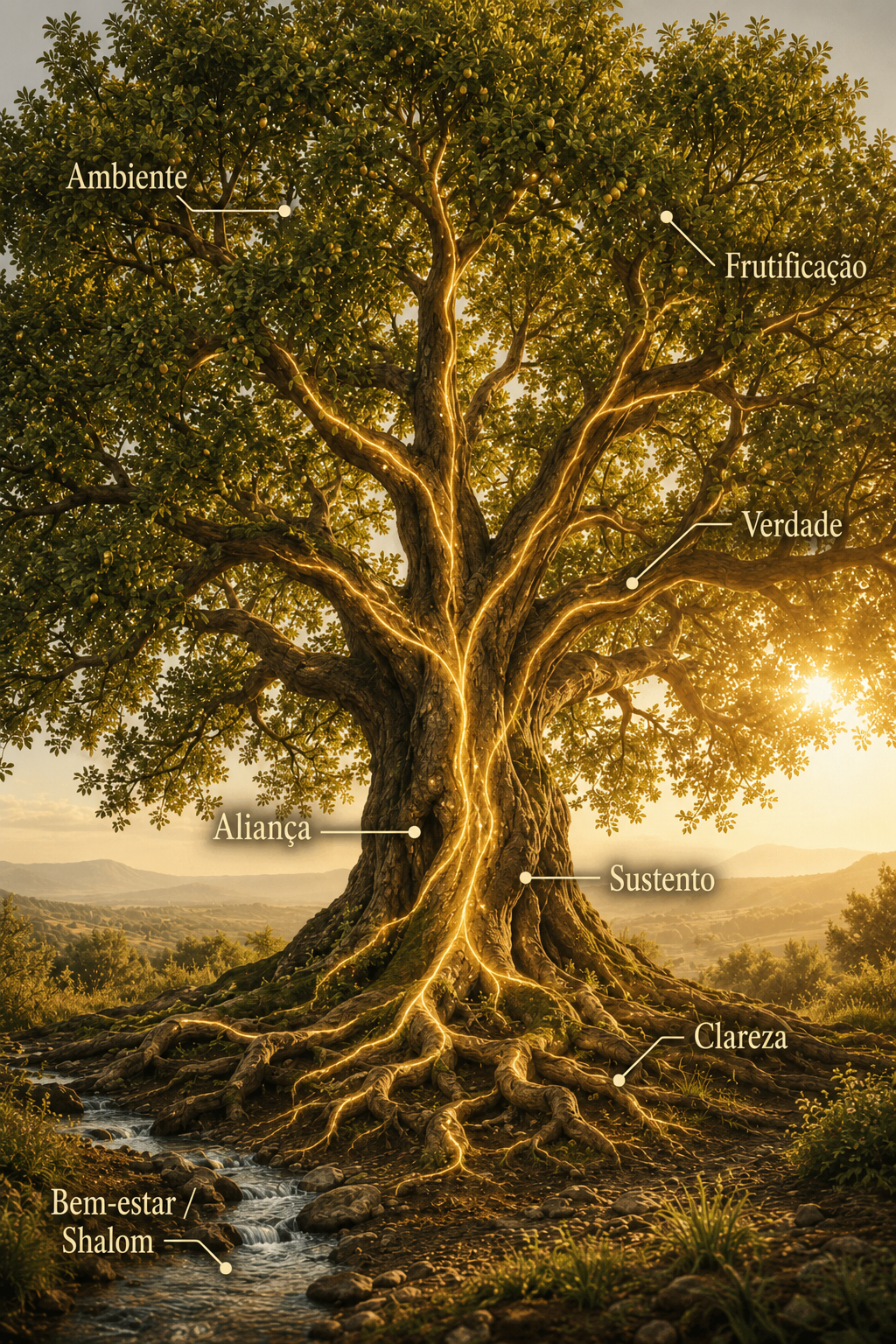
These seven strengths are not seven loose things. They hold one another up, and that is why I like to imagine them not as a list, but as a living system, a tree.
Clarity is the root, giving direction and sustaining everything underneath. Alliance is the trunk, the bond that keeps the tree firm over time. Truth is the branches, aligning, correcting and opening new paths. Environment is the canopy and the shade, the space in which other lives can flourish. Endurance is the bark, protecting and resisting through the hard seasons. Fruitfulness is the fruit and the seeds, the life that continues and is passed on.
And Well-being, shalom, is the water that reaches the roots and becomes sap. It is not merely a pleasant atmosphere. It is what nourishes and runs through the whole system, moving through trunk, branches, leaves and fruit. When it is missing, a tree may look strong for a while, but it begins to dry out from the inside.
Before entering each one, a word of care. For each strength, I chose a woman of the Bible as a window of observation. She is not the exclusive owner of that strength, and one woman can display several. The intention is to observe the strength in action, not to fit each woman into a single box.
The first strength is Clarity. The question it asks is simple to state and hard to live: how do I distinguish what I am perceiving from what I am fearing?
Let me tell you a story I carry to this day. When I was younger and lived in Rio de Janeiro, I would walk home from school at night. At one point, I realized I was being followed. A hooded man was behind me. My first reaction was to look around for someone. The street was empty, everything closed, no one there. I knew that screaming would make it worse, and that running would probably fail, because he would catch up to me.
Then something happened that I still try to explain. A strange calm came over me. I lifted my heart to God and asked for help with the plan I was about to carry out: to keep walking calmly toward the building where I lived, on the other side of the street. Without letting him notice, I slid my hand over and took the gate key, because there would be no time to ring the intercom. I set the key between my fingers, ready to hit the lock on the first try. I walked an entire block like that. When I reached the front of the building, I ran, hit the lock, opened it and slammed the gate shut behind me. The man ran when he saw me run, but when he put his hands on the gate, it was already closed.
That night, the clarity to see the best path spared me from a terrible harm. Notice what happened inside me. I did not ignore the danger, and I did not surrender to panic either. I separated the fact, someone following me on an empty street, from the reactions fear was offering, and I chose the response the situation truly called for. That is Clarity.
The Bible has a woman who shows this strength in action. Her name is Abigail, in 1 Samuel 25.
"His name was Nabal and his wife's name was Abigail. She was an intelligent and beautiful woman, but her husband was surly and mean in his dealings; he was a Calebite."
The word translated "intelligent" describes good sense and practical discernment.
The context was tense. Nabal, Abigail's husband, had insulted David, the future king of Israel, even after David's men had protected the family's shepherds. Enraged, David marched out with four hundred armed men, determined to kill every man of that household. That is when Abigail acted. She heard a servant's report, did not panic, prepared provisions and went out to meet David. She spoke to him in a way that honored him and, at the same time, kept him from shedding blood without cause and from carrying that guilt forever. She did not predict the future nor control the outcome. She saw enough to respond with wisdom.
Mature Clarity is not anxiety that tries to foresee everything, nor hypervigilance that reads a threat into everything. It observes, separates fact from fear, seeks confirmation and is willing to revise its own reading.
Clarity is not foreseeing everything. It is seeing enough to respond with wisdom.
The second strength is Alliance. Its question cuts deep: do I stay out of conviction or out of fear?
Ruth is a powerful window into this strength. She could have gone back to her land, and Naomi herself released her. Even so she chose to stay, and she spoke one of the densest declarations of loyalty in all of the Bible. It was not romanticism nor fear of losing. It was a conscious choice, with a cost.
"Don't urge me to leave you or to turn back from you. Where you go I will go, and where you stay I will stay. Your people will be my people and your God my God."
Mature Alliance protects the bond without abandoning the truth, and knows how to set limits. It is not enduring everything, it is not self-abandonment, and it is not staying in what wounds. In daily life, this strength shows up in the friend who stays without erasing herself, in the marriage that is built without either person disappearing, in the loyalty that does not become silent submission.
Alliance is not enduring everything. It is protecting the bond without losing yourself.
The third strength is Truth. The question it asks is uncomfortable: do I want to say this truth to restore the path, or only to prove I am right?
In the New Testament, Priscilla, alongside her husband Aquila, heard an eloquent preacher named Apollos and noticed something was missing in his teaching. Without any title and without humiliating anyone, the two of them explained the way of God to him more accurately (Acts 18:24 to 26). It is the courage to say what needs to be said looking someone in the eye, without manipulation and without cowardice. How many times have we silenced an important truth to keep the peace, when in fact we were only avoiding discomfort?
Mature Truth illuminates, realigns and gives responsibility back. It is not aggression disguised as honesty, nor silence disguised as peace.
The truth that comes from the design does not humiliate. It illuminates and realigns.
The fourth strength is Environment. Its question is revealing: does the environment I am creating let people grow, or does it make everything depend on me?
Lydia, in Acts 16, opened her home and turned it into a base for an entire community. Creating an environment is not decoration, it is not keeping everyone happy at the expense of yourself, and it is not control. It is cultivating truth, safety, belonging and order. The distortion of this strength appears when care turns into perfectionism, control and the attempt to manage everyone's emotions.
Creating an environment is not preventing all discomfort. It is cultivating a space where life flourishes.
The fifth strength is Endurance, the resistance that crosses long processes without hardening. Its question asks for honesty: does this process call for staying, for a new action, for a limit, or for the courage to end it?
Hannah, in 1 Samuel 1, went through years of waiting and pain, carrying her cry before God. Mature Endurance stays whole and responsive through the crossing. But here a serious caution is needed: to endure is not to glorify suffering, it is not passivity, and it is not insisting without discernment. The Bible must never be used to justify staying in what destroys.
To endure is not to stay still. It is to remain whole, knowing when to continue, when to change and when to ask for help.
The sixth strength is Fruitfulness. Its question is generous: what has God already formed in me that can nourish, guide or open a way for someone else?
Mary Magdalene was the first to announce the resurrection, and her word crossed generations (John 20). Fruitfulness is far greater than biological motherhood, though it includes and honors it too. It is forming people, passing on what we have learned, building what will last. It shows up when you invest in someone without any guarantee of return, when you teach so the next person can go further, when you create something that will continue after you. The distortion appears when fruitfulness turns into ceaseless productivity to prove one's worth, or into comparing results.
To be fruitful is not to prove your own worth. It is to let what we received from God keep generating life.
The seventh strength is Well-being, shalom. Its question unmasks a great deal: am I building a true peace, or only avoiding discomfort?
The woman who suffered from bleeding, after twelve years, heard from Jesus "go in peace" (Mark 5). That was not only a farewell, it was the giving of wholeness. Shalom, in the Hebrew tradition, is not the absence of problems nor an artificial calm. It is peace with a foundation, the kind that crosses the storm without losing its footing. The distortion of shalom is false peace: silence in the face of conflict, escape, the appearance of harmony.
Shalom is not a life without storms. It is a life that does not lose its foundation within them.
An important detail of this model is that the strengths balance one another. When one operates in isolation from the rest, it tends to distort.
Clarity without Alliance can become coldness, the lucidity that sees everything but bonds with no one. Alliance without Truth can become self-abandonment, the loyalty that stays silent so as not to lose the other. Truth without Well-being can become aggression, the frankness that wounds instead of realigning. Environment without limits can become control. Endurance without discernment can become destructive permanence. Fruitfulness without roots can become empty productivity. And Well-being without Truth can become a false peace that avoids all confrontation.
That is why the goal is never to develop a single strength to the maximum, but to let them grow together, as parts of the same tree.
The same strength can operate in a healthy way or mix with fear, control, exhaustion or the need for approval. Recognizing the difference is the beginning of maturing.
| Strength | Mature expression | Wounded expression |
|---|---|---|
| Clarity | Separates fact, perception and fear; seeks confirmation | Anxiety, hypervigilance, constant suspicion |
| Alliance | Protects the bond without self-abandonment; knows limits | Enduring everything, self-abandonment, staying in what wounds |
| Truth | Confronts with love and gives responsibility back | Aggression, or silence disguised as peace |
| Environment | Cultivates safety, belonging and order | Control, perfectionism, managing everyone's emotions |
| Endurance | Crosses whole and knows when to continue or change | Passivity, insisting without discernment, exhaustion |
| Fruitfulness | Lets what it received generate life in others | Productivity to prove worth, comparison |
| Well-being | Peace with a foundation that crosses the storm | False peace, escape, the appearance of harmony |
If you look again at these women, you will notice a common thread. Abigail acted at the decisive moment. Ruth stayed out of conviction. Hannah cried out for years. The woman with the bleeding did not give up after twelve years. There is something beneath every mature strength, and it is not an eighth strength. It is a posture: perseverance before God. I like to sum it up in one phrase: until heaven answers.
This dimension is tied to my own history. I have a great capacity to persevere, and one of the hardest things for me is to give up. That helped me cross long processes, sustain people and fight for my family. But it also had to mature, because not every staying is perseverance.
So it is important to understand what the phrase until heaven answers does not mean. It does not suggest that our faith obligates God to confirm our desires. Heaven can answer in many ways: opening a door, closing a door, changing the circumstances, transforming something within us, asking us to wait, or pointing to a new direction.
To persevere before God is not to force heaven to confirm what I want. It is to remain with Him until the answer comes, whatever it may be.
Before we finish, I want to invite you to a simple exercise. It is not a test, and there is no score. It is just a beginning of recognition.
Take the seven strengths: Clarity, Alliance, Truth, Environment, Endurance, Fruitfulness and Well-being. Choose one you recognize operating most naturally in you, the one that shows up almost effortlessly. Now choose a second one: some strength of yours that, at some point in life, was called a flaw, by you or by others.
Write one sentence for each. About the first: where has it been showing up lately? About the second: what would change if you started to see it as a strength to mature, rather than a problem to hide?
Do not answer too quickly. Let the questions sit for a while. This small recognition is already the first step of maturing, and it is from here that the deep study will begin.
Set aside a few minutes, if possible with a notebook nearby, and answer honestly before God.
Lord, thank you because none of the strengths you placed in me is an accident. Teach me the difference between what I perceive and what I fear, between staying out of conviction and staying out of fear, between true peace and escape disguised as peace.
Where a strength of mine was wounded, heal it. Where it was exploited, restore it. Where it is still immature, mature it. And give me the courage to persevere before you, until heaven answers, whatever your answer may be. Amen.
Naming the seven strengths is not creating one more ruler for you to measure and pressure yourself against. It is the opposite. It is giving the right name back to things that may have been called by the wrong name for a long time.
You do not need to exercise all the strengths with the same intensity, or in the same season. Some will be more developed, others dormant, others wounded and asking for care. And each of them is within a process.
Being Ezer, after all, was never a synonym for being exhausted. Not every need around you is a call for you. To care is not to manage everyone's emotions, to endure is not to stay indefinitely, and generating life also requires receiving care. Sometimes setting a limit is one of the highest forms of faithfulness.
What you spent your life calling a flaw, God may be calling a strength.
This article was a brief map of the seven strengths. In the complete PDF study, you will find the biblical research for each strength, the context of each woman, the interpretive cautions, the exercises with writing space and a process of maturing across seven weeks. Fill in your details to access the complete material.
Fill in your details to receive the complete material of "Ezer Kenegdo: The Seven Strengths of a Woman".
Your data will be used only to send you this study and communications related to Priscila Abondanza's content.
By submitting this form, you agree to the use of your data to receive this study and related communications. Your data will not be sold or shared.
Haven't read the previous studies? Ezer Kenegdo — The Help of God · God's Purpose Where I Am