Deborah, Jael and the courage to answer God's call right where we stand
Start readingIn the first study on this blog, we discovered that ezer kenegdo does not describe a fragile, secondary or passive woman. The expression in Genesis 2:18 leads us to the image of a corresponding strength, a powerful help and a presence created by God to take part in His work.
Now a new question arises: how does that strength show itself in real life?
Is there only one way for a woman to live out her purpose before God?
Along my journey, I have had the opportunity to meet extraordinary women. Women who built history wherever they went. And I noticed something curious: however different their paths were, the questions were almost always the same.
Am I in the right place? Is it possible to be a good mother and desire a career? If I decide to dedicate myself entirely to my family, will I be leaving something behind? Can I change my mind along the way? Does God approve of the path I have chosen?
I carried those questions too. And they are what I want to talk with you about in this study.
For a long time, it seemed to me that there had to be a single answer. As if there were one exact model of the fulfilled, God-obeying woman, and my task was to discover that model and fit myself into it.
I decided to build a life as a woman, a mother and a professional. I wanted to raise a family, live motherhood, work in the marketplace, study, develop projects and exercise the talents God gave me. That choice brought immense joys — and it also brought questions, insecurities and the very real fear of not being able to sustain every area at the same time.
Over the years, I met friends who made choices different from mine. Some dedicated themselves entirely to motherhood. Others paused their careers for a season. Some returned to professional life after years away. Others changed direction completely in the middle of the road.
And here is what struck me most: in very different stories, I saw expressions of abundance, meaning and fulfillment.
The conclusion is not that any decision is automatically right. The conclusion is something else:
Abundance was not tied to a single format of life. It appeared when a woman placed her choices before God, took responsibility for them and lived her decision with presence, courage and wholeness.
The problem is that, when we believe there is only one way to get it right, comparison settles in. And comparison breeds guilt: the woman who works feels guilty for not being at home; the woman who is at home feels guilty for not having a career; and both feel insufficient before a model that no one knows exactly who defined.
The Bible has something surprising to say about this. And it says it through two women who lived the same story, in completely different places.
There is not only one way for a woman to live out her purpose. There is a life that needs to be placed before God with sincerity, courage and responsibility.
To meet these two women, we need to visit the book of Judges, chapters 4 and 5.
The period of the judges was a difficult time in Israel's history. Before there were kings, the people lived in repeating cycles: they drifted away from God, were oppressed by enemy nations, cried out for help, were delivered by a judge raised up by God and, some time later, drifted away again. When I read these stories, I even feel a little distressed by such a repetitive cycle.
Judges 4 begins exactly in one of those cycles. The text says the Israelites once again did evil in the eyes of the LORD and were given into the hands of Jabin, king of Canaan. The commander of Jabin's army was named Sisera, and one detail of the narrative shows the size of the threat: he had nine hundred iron chariots and cruelly oppressed Israel for twenty years (Judges 4:1–3).
Nine hundred iron chariots may not mean much to us today. But in that period, war chariots represented enormous military superiority. It was combat technology Israel did not possess. Against them, the people seemed to stand no chance. Let's just say things looked very grim for God's people.
The song of Judges 5 helps us see how that oppression reshaped everyday life: the roads were abandoned, travelers took winding paths and village life had grown weak (Judges 5:6–7). Fear had reorganized the routine of an entire nation.
Here a bridge of reflection is fitting — and let me be clear that it is an analogy, not an equivalence between the war Israel lived through and our conflicts today. Not every oppression comes to us in iron chariots. Some arrive in the form of guilt, fear, comparison, overload, social expectations and the feeling that we do not have enough resources to move forward.
How many of us have also reorganized our lives because of fear? We avoid conversations, postpone decisions, shrink dreams and begin living by alternative routes.
It was in that scenario that God raised up a woman.
The biblical text introduces Deborah directly:
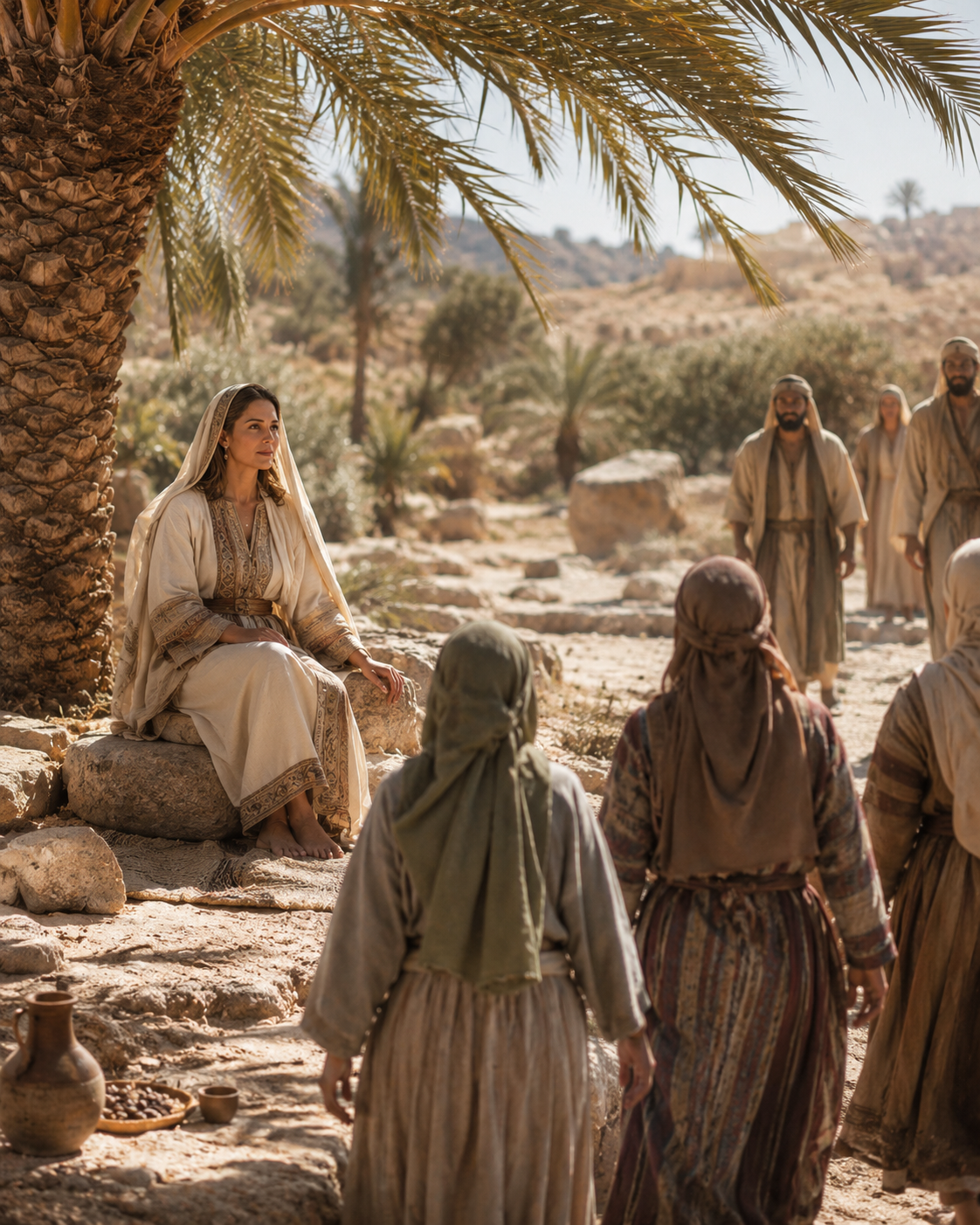
"Now Deborah, a prophet, the wife of Lappidoth, was leading Israel at that time. She held court under the Palm of Deborah between Ramah and Bethel in the hill country of Ephraim, and the Israelites went up to her to have their disputes decided."
In some translations the tree appears as a date palm — the same tree, which became known as the Palm of Deborah.
Notice who this woman was: a prophet, a wife, a judge of Israel, a voice of guidance in a period of oppression. The people went up to her to settle their disputes. In a time of fear and disarray, there was a place where people found direction — and in that place was Deborah.
Deborah perceived the historical moment and recognized God's direction: that is her discernment. She spoke and acted in the face of a militarily superior enemy: that is her courage. She summoned Barak, delivered the word she had received and mobilized the people: that is her leadership. The song itself records this rising: "Wake up, wake up, Deborah! Wake up, wake up, break out in song!" (Judges 5:12). And when victory came, the song did not build a narrative centered on her — it recognized that the victory belonged to the LORD and celebrated the participation of many (Judges 5:31). That is her humility.
There is one more precious detail. In the song, Deborah describes herself this way: "I arose, a mother in Israel" (Judges 5:7). A woman who led a nation chose, for herself, an image of care, protection and responsibility for the people.
This breaks a false opposition we still carry today: the idea that strength and care cannot dwell in the same woman. Deborah did not need to abandon the qualities linked to motherhood in order to lead. She led as one who cares.
And about the palm tree, it is worth saying clearly: the Bible attributes no special power to that tree. It was a simple place, between Ramah and Bethel.
It was not the palm tree that gave Deborah her significance. It was Deborah's faithfulness that turned that place into a landmark.
Deborah sent for Barak and delivered to him the LORD's direction: to gather ten thousand men at Mount Tabor, because God would give Sisera into his hands (Judges 4:6–7).
Barak's answer is well known: "If you go with me, I will go; but if you don't go with me, I won't go" (Judges 4:8).
It would be easy to turn Barak into a caricature, as if he were merely a cowardly man. But the text deserves a more balanced reading. Barak answered the call, gathered the men, went down from Mount Tabor and fought the battle (Judges 4:12–16). He had a real responsibility, and he took it up. What his answer reveals is that he recognized in Deborah a presence he needed in order to move forward.
And Deborah agreed to go. She did not lead only from a distance: when it was necessary, she walked alongside.
But she added a word that prepares the next scene of the story: because of the path he had chosen, the honor for Sisera's defeat would not be Barak's — the LORD would deliver the enemy into the hands of a woman (Judges 4:9).
What no one imagined was where that woman would be.
The battle took place, and the LORD gave Israel the victory. Facing defeat, Sisera, the feared commander of the nine hundred iron chariots, fled on foot — and arrived at the tent of Jael, the wife of Heber the Kenite (Judges 4:17).
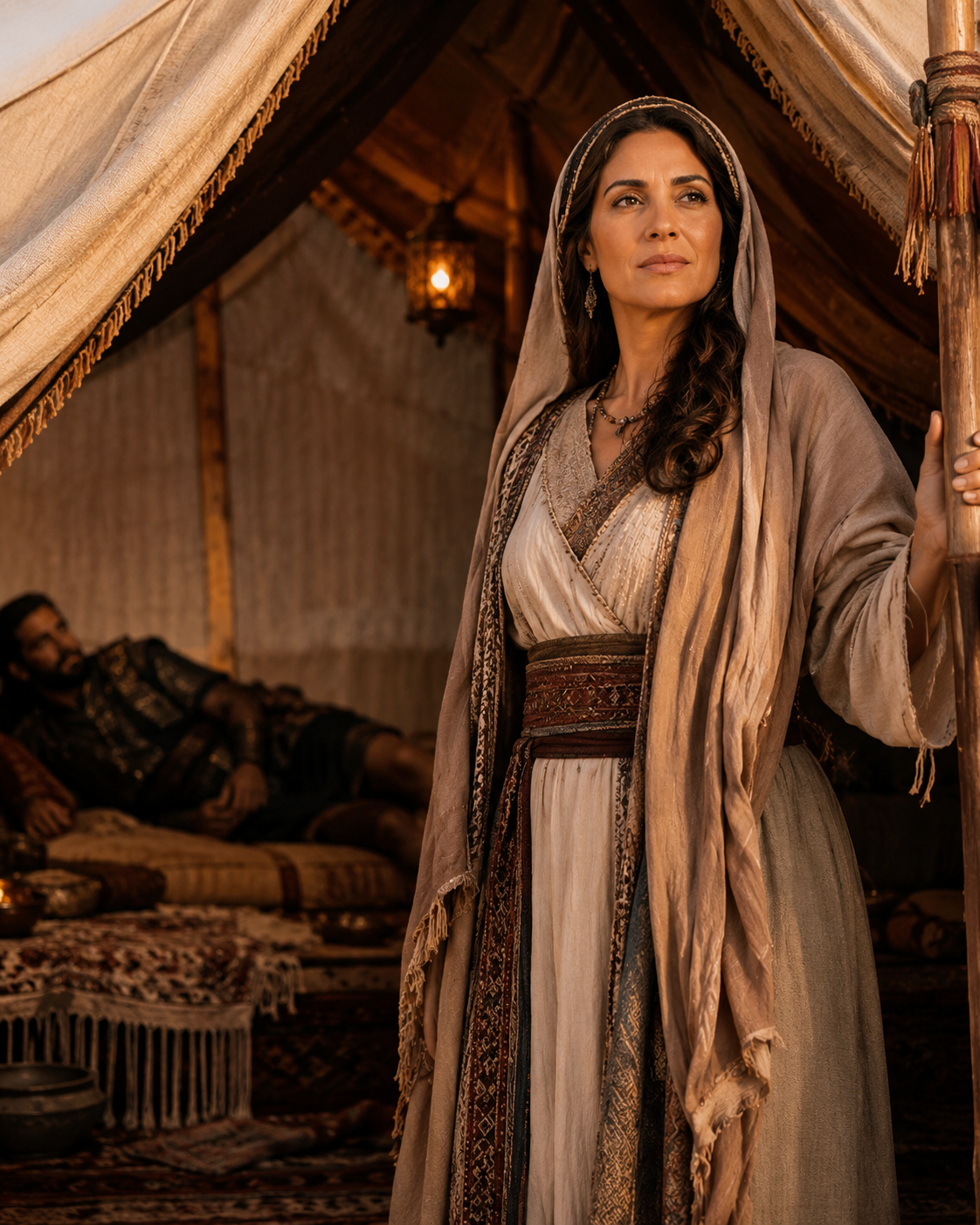
There were peaceful relations between the house of Heber and the house of Jabin, which is probably why Sisera considered that place safe. Jael went out to meet him, invited him in, covered him and, when he asked for water, offered him milk. Exhausted, Sisera fell asleep. Then Jael took a tent peg and a hammer — and killed the enemy commander. When Barak arrived, pursuing Sisera, it was Jael who showed him how it had ended (Judges 4:18–22). From that day on, Israel grew stronger and stronger, until Jabin's oppression came to an end (Judges 4:23–24).
I need to make an honest pause here. This episode is part of a war narrative from the ancient world, and the Bible records it with all the harshness that war carries. We will not romanticize the violence of this scene, nor use it to encourage any kind of aggression. That is not what the text is about.
What the narrative highlights — and what the song of Judges 5 celebrates — is something else: the courage, the strategy and the decisiveness of an unexpected woman, at the decisive moment of a people's liberation. The song goes as far as calling her "most blessed of women" (Judges 5:24–27).
Notice one detail: the tent peg and the hammer were objects from Jael's daily routine, common tools of life in tents. Narratively, the elements of her everyday life became decisive instruments. This does not mean that ordinary objects hide secret spiritual meanings. It means something far more practical:
Jael did not need the resources of an army to take part in that moment. She used what was within her reach.
She appears in her domestic environment, inside the tent where she lived. And it was from that space — not from a palace, not from a battlefield — that she entered the story of Israel's liberation.
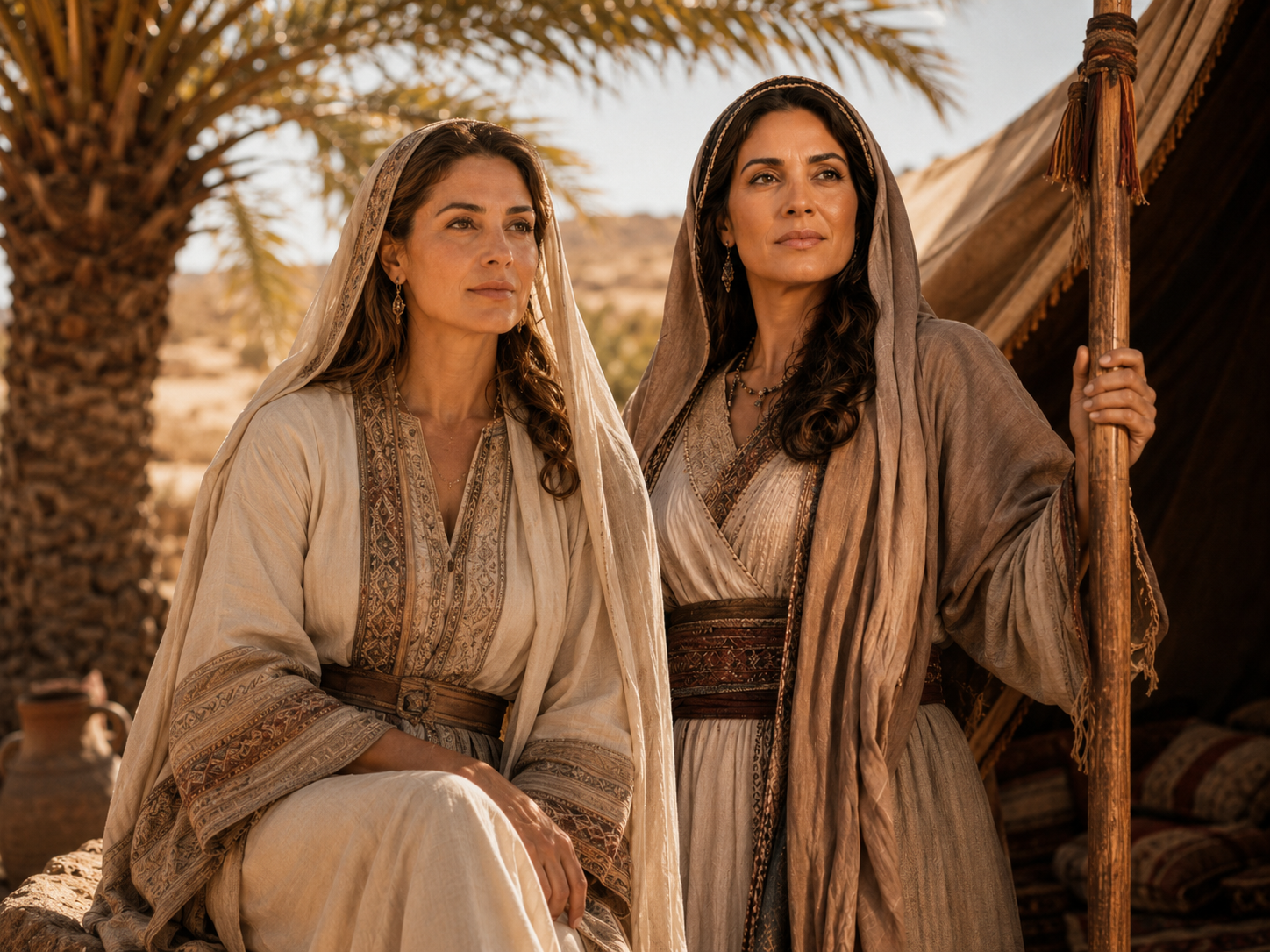
Now place the two stories side by side.
Both took part in the same story of liberation.
God did not need to turn Jael into Deborah in order to use her. And He did not need to diminish Deborah in order to honor Jael.
The victory passed through the battlefield, but it also passed by a palm tree and entered a tent.
When I look at these two women, I think of the women I know today. Deborah may remind us of those who work, lead, counsel, build businesses, make decisions and exercise influence in public spaces. Jael may remind us of those whose work happens mostly at home, in motherhood, in caregiving, in managing daily life — in barely visible battles and silent decisions that sustain entire families.
I make these connections carefully, because they are illustrative. Deborah was not a modern executive, and Jael should not be reduced to the contemporary image of a housewife. They were women of another time and another context. But the parallel serves to show a truth that crosses the centuries: God does not limit His work to a single environment.
Deborah's palm tree and Jael's tent became places of purpose because two women did not stand back from the moment that was set before them.
If God acted through a public leader and through a woman inside her tent, we need to confront two errors that still wound many of us.
The first error is to diminish the woman who works professionally, leads or exercises public influence. It is the idea that career is incompatible with faith, that female leadership means abandoning femininity, that wanting to develop talents is selfishness, that a working mother loves her family less. Deborah's story supports none of this — she led a nation and called herself a mother in Israel, in the same line of the same song.
The second error is to diminish the woman who dedicates herself to the home, the family or motherhood. It is the idea that working at home means having no purpose, that dedicating yourself to your family is a lack of ambition, that daily care is an inferior contribution. Jael's story supports none of this — it was inside a tent that the outcome of a twenty-year war was decided.
Neither of these choices is free of responsibilities, limits and renunciations. Every real choice costs something. But the problem is not in the diversity of the paths.
The problem begins when we turn a personal choice into a rule for every other woman.
And there is something that needs to be said tenderly to those who have changed paths — or wish to. A woman may dedicate one season of her life to her career, slow down to care for her family, go back to school, return to a profession, start a business, close a chapter, begin again. Changing paths is not automatic failure. And it is not automatically God's direction either.
That is why the invitation is not to decide on impulse, nor to stay out of fear. It is to discern: to pray, examine your motivations, seek wisdom, weigh your responsibilities, listen to mature counsel, recognize your limits and perceive the timing.
Faithfulness does not mean remaining forever in the same form of life. In some moments, being faithful will mean staying. In others, it will mean having the courage to change.
I want to tell a story I carry with me to this day.
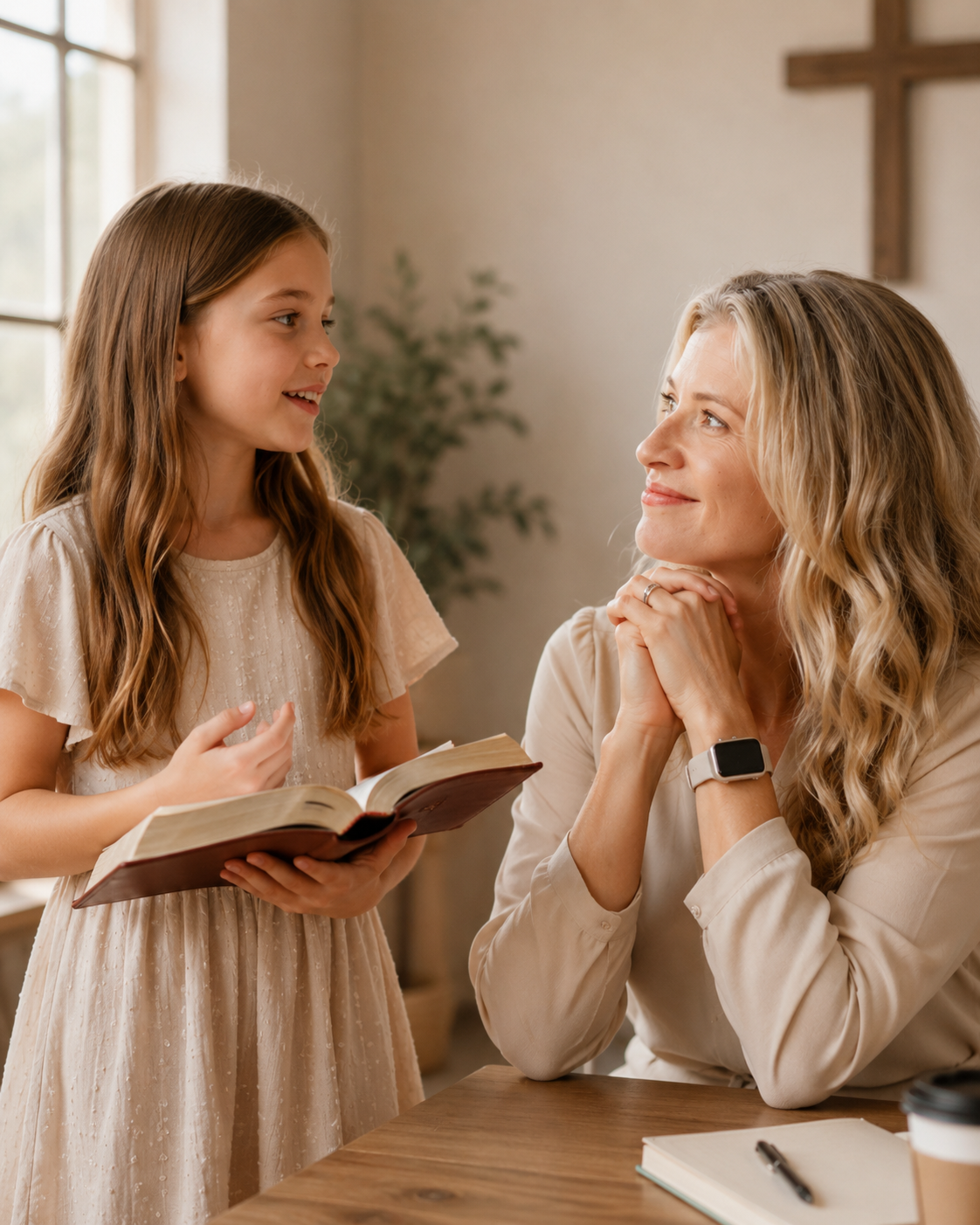
When I was younger, I taught children at church. I decided to give one of my students, a girl named Amanda, an invitation: she would prepare a study on a passage of the Bible she liked and bring it to our next meeting. She was about ten years old. And she chose Jeremiah 1.
Amanda spoke about Jeremiah's call, about his insecurity over his own youth and about God's answer. I had prepared that activity believing I would teach the children. That day, it was a child who placed courage inside me.
Let me show you the text she chose. God calls Jeremiah to be a prophet, and he reacts like this:
"'Alas, Sovereign LORD,' I said, 'I do not know how to speak; I am too young.' But the LORD said to me, 'Do not say, "I am too young." You must go to everyone I send you to and say whatever I command you. Do not be afraid of them, for I am with you and will rescue you,' declares the LORD."
An important clarification: the Bible does not tell us Jeremiah's exact age. Some translations say "I am too young"; others render it "I am only a child". The central point is not the age — it is that Jeremiah considered his youth and his inexperience impediments to the call.
And God's answer was not to deny his youth. It was to redirect his gaze: do not say you are too young; you will go; you will speak; do not be afraid; I am with you. Then God touched Jeremiah's mouth and declared that He had put His words there (Jeremiah 1:9).
The feeling of insufficiency may explain our fear, but it does not have to determine our answer.
Amanda was speaking about someone who felt too small to answer God. And, without knowing it, she became the voice that strengthened her teacher.
That day, I had asked a child to learn and teach something. But it was God who used that child to teach and strengthen the teacher.
God can use a prophet under a palm tree. A woman inside a tent. An insecure young man. A ten-year-old girl. Influence does not depend only on age, position or visibility.
Now gather all these stories together for a moment.
Deborah could have considered the times too hostile. Twenty years of oppression and nine hundred iron chariots.
Jael could have considered her tent too ordinary. Who decides a war from inside her own home?
Jeremiah considered his age insufficient. And he said so to God.
Amanda could have been considered too young to teach anything capable of marking an adult.
And I could have considered it too complex to try to be a woman, a mother and a professional at the same time.
Perhaps you have been considering yourself too small. Too old. Too young. Too tired. Too late. Too ordinary. Too busy. Too unprepared. Too wounded. Too far from the ideal scenario.
God does not begin with the size of the resources we have. He begins with our willingness to hear Him and respond.
You do not need to become Deborah to live with purpose. You do not need to become Jael. You do not need to reproduce another woman's choice — not your mother's, not your friend's, not that of the woman you admire on social media.
The decisive question is not "who should I look like?". The decisive question is another one:
God, who are You calling me to be in this time, in this place, and with what You have placed in my hands?
We have arrived at the title of this study. And it needs to be understood well.
We often treat purpose as a single great hidden mission that we must discover so that life can finally begin. But purpose, in the Bible, looks much more like a life lived in response to God: who we are becoming, how we use our gifts, the way we treat people, the responsibilities we take on, the environments we transform, faithfulness in the everyday and the readiness to act when the moment demands it.
God's purpose does not begin only when we discover a great mission. Very often, it is already being lived in the small answers of faithfulness we offer every day.
Before being a destination, purpose is a way of walking with God.
That is why God's purpose for women does not fit into a single format of life — and it is also why "God's purpose where I am" does not mean you must remain forever in the same place. God also calls people to leave, to change, to stop, to begin again, to study, to lead, to rest, to care, to rebuild, to confront and to wait. The meaning of the phrase is different: we do not need to wait for a perfect scenario to begin responding to God.
Deborah served under a palm tree. Jael responded inside a tent. Jeremiah was called while he still felt young. Amanda taught me when she was only ten years old. Purpose does not depend only on the scenario. It reveals itself when a person hears the voice of God and offers Him, with courage, the place they occupy, the resources they have and the life they are building.
God's purpose does not begin only at a destination. It also shows itself in the way we walk with Him where we are today.
My desire for you, as you finish this reading, fits into a phrase I learned by living it: may we be, with wholeness, who God calls us to be in the place where we are.
Wherever you are, do not diminish yourself, do not compare yourself and do not hold back. Listen to God, examine your heart and move forward. The palm tree, the tent, the classroom, the company, the home or the place where you find yourself today can become territory of purpose when your life answers: "Here I am."

Set aside a few minutes, if possible with a notebook nearby, and answer honestly before God.
Lord, help me to recognize the purpose that can be lived in the place where I am. Free me from comparison, from fear and from the need to reproduce other women's stories.
Give me discernment like Deborah, courage like Jael and readiness to answer Your call even when I feel small or unprepared. Show me what You have placed in my hands and teach me to use it with wisdom, humility and faith.
May my life not be guided merely by people's expectations, but by Your presence and Your direction. Amen.
This content is an introduction to the complete study God's Purpose Where I Am. In the full material, you will find the detailed context of Judges 4 and 5, comparisons between Bible translations, guided reflections, personal exercises, questions for groups and a practical journey to discern God's purpose in the season you are living.
Fill in your details to receive the complete material of "God's Purpose Where I Am — Deborah, Jael and the courage to answer God's call".
Your details will be used only to send this study and communications related to Priscila Abondanza's content.
By submitting this form, you agree to the use of your data to receive this study and related communications. Your data will never be sold or shared.
Haven't read the first study yet? Ezer Kenegdo — The Help of God