Bible study · A continuation of Ezer Kenegdo

In Eden, God Did Not Divide Tasks

He gave a mission to two

A study on the woman of valor, the man of valor and the mission God entrusted to both.

Start reading
↓
Introduction

The man of valor I was also looking for

How many times have you heard that the man is the provider and the woman is the one who takes care of the home and the children? Maybe you heard it at church, maybe at home, maybe you simply saw it happen, without anyone needing to say a word. For many of us, that sentence arrived looking like a Bible verse.

I have always talked a lot about the woman of valor. But I need to confess something: I was also looking for a man of valor. Someone who knew who he was, who knew in whom he believed, and for whom God mattered more than anything else. I had already encountered God, and I knew that when we encounter Him, we begin to love the other person intensely, the way He loves us. That would be security for me.

And God gave me the grace of meeting Caio. A man who complements me, and whom I complement. In more than twenty-five years, we have never seen each other as superior or inferior to one another.

A mature woman in a moment of reflection at the kitchen table, with an open Bible and a cup of coffee
I have always talked about the woman of valor. But I was also looking for a man of valor.

In the first study on this blog, we discovered that ezer kenegdo does not describe a fragile or secondary woman, but a corresponding strength, a help face to face.

In the second, we saw that there is not just one way for a woman to live her purpose. Now I want to talk about a question that runs through many homes, including mine:

Did God determine that the man provides and the woman cares? Or did He give the two of them a shared mission?

To answer honestly, we will need to separate three things that usually arrive mixed together: what God designed in the beginning, what the fall wounded, and what history and culture added later.


Genesis 1:26–28

Before any task, a mission

The Bible begins with a mission, not with a division of tasks.

Genesis 1:27–28 · NIV

"So God created mankind in his own image, in the image of God he created them; male and female he created them. God blessed them and said to them, 'Be fruitful and increase in number; fill the earth and subdue it. Rule over the fish in the sea and the birds in the sky and over every living creature that moves on the ground.'"

Notice a detail that the Hebrew makes very clear: all of these verbs are plural. Be fruitful, increase, fill the earth, subdue it and rule over it. God did not say to Adam "rule" and to Eve "bear children". He said to both of them: "you".

Bringing forth life and caring for creation do not appear as two departments, one masculine and one feminine. They appear as a single mission, entrusted to two people who together bear the image of God.

I keep thinking about how many couples' conversations would change if they started here. Before asking "who does what?", the question of Genesis is a different one: "what is our mission?".

Core idea

In Eden, God did not divide tasks; He gave a mission to two.

A mature couple planting seedlings side by side in a vegetable garden, in morning light
Bringing forth life and caring for creation: a single mission, entrusted to two.
Genesis 2:18–24 · Ezer kenegdo

Face to face: the help God designed

Genesis 2 tells the same creation story through a closer lens. God forms the man from the dust of the ground, places him in the garden, and then makes a surprising statement:

Genesis 2:18 · NIV

"The LORD God said, 'It is not good for the man to be alone. I will make a helper suitable for him.'"

In everything God had created until then, the refrain was "and God saw that it was good". This is the first time something is "not good". The man alone does not complete the mission.

The Hebrew expression we studied in the first article is ezer kenegdo. Ezer is a word used most of the time for God himself, as the help of his people ("My help comes from the LORD, the Maker of heaven and earth", Psalm 121:2). Kenegdo means "as in front of him", someone at the same level, face to face. Neither above nor below.

And right after that comes a verse that often goes unnoticed:

Genesis 2:24 · NIV

"That is why a man leaves his father and mother and is united to his wife, and they become one flesh."

In that ancient world, it was the woman who left her father's house to live with her husband's family. The text reverses the direction: it is the man who leaves. And the verb "to be united" is the same one used for the loyalty of a covenant. The design of Eden is covenant, not a hierarchy of roles.

Genesis 2:15

Work was born in the garden

There is a common idea that work is a punishment, a consequence of sin. But look at what the text says, even before the fall:

Genesis 2:15 · NIV

"The LORD God took the man and put him in the Garden of Eden to work it and take care of it."

The two Hebrew verbs here are avad (to work, to serve) and shamar (to keep, to take care of). Interestingly, they are the same verbs used later to describe the service of the Levites in the tabernacle (Numbers 3:7-8). The garden was a place of worship, and working in it was part of that worship.

This changes a lot for me. Work was not born from sin. It is part of the design. And if the mission of Genesis 1 was given to both, the work of cultivating and caring also belongs to both.

Genesis 3:16–19

What the fall describes, and what it does not command

Then we come to Genesis 3, the chapter of the rupture. After sin, God announces the consequences:

Genesis 3:16–17 · NIV

"To the woman he said, 'I will make your pains in childbearing very severe; with painful labor you will give birth to children. Your desire will be for your husband, and he will rule over you.' To Adam he said, '[…] cursed is the ground because of you; through painful toil you will eat food from it all the days of your life.'"

Condensed quotation: omitted passages are marked with […].

Read it again and notice the word that repeats: pain, painful toil. In Hebrew it is the same root, itsavon, for both of them. The woman suffers in bringing forth; the man suffers in cultivating. Both parts of the mission of Genesis 1, bringing forth life and caring for the earth, now carry pain.

The text is not creating a division of realms ("children for her, provision for him"). It is showing that the whole mission was wounded. And the archaeologist Carol Meyers reminds us that, in an agricultural society like ancient Israel, the woman also worked hard in the fields. She gave birth and she cultivated, both with toil.

And there is the most delicate sentence: "Your desire will be for your husband, and he will rule over you". The word translated as desire, teshuqah, appears only three times in the Old Testament. One of them is in the very next chapter, when God speaks to Cain about sin: "it desires to have you, but you must rule over it" (Genesis 4:7). The construction is the same. That is why many scholars understand Genesis 3:16 as describing the beginning of a power struggle between man and woman, something that did not exist before.

Here is a point that brought me a lot of freedom: the man's rule over the woman appears for the first time in the Bible after sin, as a consequence, and not in Genesis 1 and 2, as design.

And it is a description, not a command. It is like the pain of childbirth and the thorns of the ground. Nobody thinks they are disobeying God when they use anesthesia in childbirth or pull weeds from the garden. When Jesus was questioned about marriage, He himself pointed back to before the fall: "it was not this way from the beginning" (Matthew 19:8). The beginning is the reference.

The fall

The fall did not create work; it made it heavy. And it did not create the difference between man and woman; it wounded the relationship between them.

I want to make this clear: Genesis 1:27 celebrates difference, "male and female he created them". The problem is not that we are different. It is what sin did to the way we relate to each other.

History and culture

Where the "man as provider" came from

If the Bible does not determine that the man provides and the woman cares, where did this idea, so strong, come from? History helps us answer.

In ancient Israel, the home was the place of production. The family lived from the land and the animals, and everyone worked. Women ground grain, wove, tended gardens and flocks, managed what the household produced and taught the children. There was no such thing as "going out to work": the work was inside the home, and it was done by men and women together.

I need to be honest here: this does not mean there was full equality. The inheritance of land passed through the men, and the woman depended legally on her father or her husband. That is exactly why the Bible insists so much on protecting the widow and the orphan. The Law protects the vulnerable woman; it does not celebrate that vulnerability as an ideal.

In the Greco-Roman world, at the time of the New Testament, philosophers such as Aristotle taught that the man belonged to the public sphere and the woman to the sphere of the home. The idea of "separate spheres" is Greek before it is Christian.

With the Industrial Revolution, in the 18th and 19th centuries, work left the home and went to the factory and the office. The father began to receive a wage outside, and the mother stayed with the home. This became a moral ideal and later, in the 20th century, a symbol of the "Christian family".

In other words: much of what we call the "biblical model" has more of the factory than of Eden.

And what about Brazil today? According to the 2022 Census by IBGE, Brazil's national statistics institute, 49.1% of Brazilian households have a woman as the person responsible. In 2010, it was 38.7%. A teaching that measures a man's worth by "being the provider" can create guilt in the woman who supports the home and shame in the man who, for a season, cannot. Without the Bible having asked for any of it.

Proverbs 31 · Ruth 2 and 3

The woman of valor and the man of valor

If there is one text often used to define "the woman's role", it is Proverbs 31. And that is exactly where the Bible surprises us.

Proverbs 31:10 · NIV

"A wife of noble character who can find? She is worth far more than rubies."

English translations have rendered this verse in different ways, from "a virtuous woman" to "a wife of noble character". These words help, but none of them can carry the full weight of the Hebrew word chayil. Chayil means strength, valor, capability. It is the word used for valiant warriors, for armies and even for wealth. "Woman of valor" or "woman of strength" may be the most faithful translation.

And what does this woman do?

She buys land, invests, sells, manages and feeds the household. The text that closes the book of wisdom describes a woman who provides. And her husband? He has full confidence in her (v. 11) and praises her: "Many women do noble things, but you surpass them all" (v. 29).

A mature woman in her home office, reviewing documents by the window, with a basket of fabrics on the desk
She evaluates, invests, manages and cares. Proverbs 31 describes a woman who provides.

I have always seen the woman of Proverbs 31 as a real woman, possible to live out. And I believe she is. But we need to understand how the text was written: it is an acrostic poem, in which each verse begins with a letter of the Hebrew alphabet, from A to Z. It is a complete portrait of the virtues of a wise woman, not a to-do list to finish before breakfast. In Jewish tradition, this poem is sung by the husband to his wife at the Sabbath table. It is a blessing, not a demand. And its center is not productivity: "a woman who fears the LORD is to be praised" (v. 30).

Now, the discovery that moved me the most in this study.

The same word chayil appears in the book of Ruth. Boaz says to Ruth: "All the people of my town know that you are a woman of noble character", an eshet chayil (Ruth 3:11). Ruth, a foreigner, a widow, who worked in the fields to support her mother-in-law.

But the book had already used the word before. When Boaz is introduced, the text calls him ish gibbor chayil, which the NIV translates as "a man of standing" (Ruth 2:1). The same valor. The same strength.

Ruth and Boaz are the couple in which man and woman receive the same title.

When I read this, I thought of my own story. I was looking for a man of valor. And I realized that the Bible does not reserve valor for one side. Both are called to be chayil.

Chayil

The same word that describes the woman of valor describes Boaz. Valor has no gender; it has character.

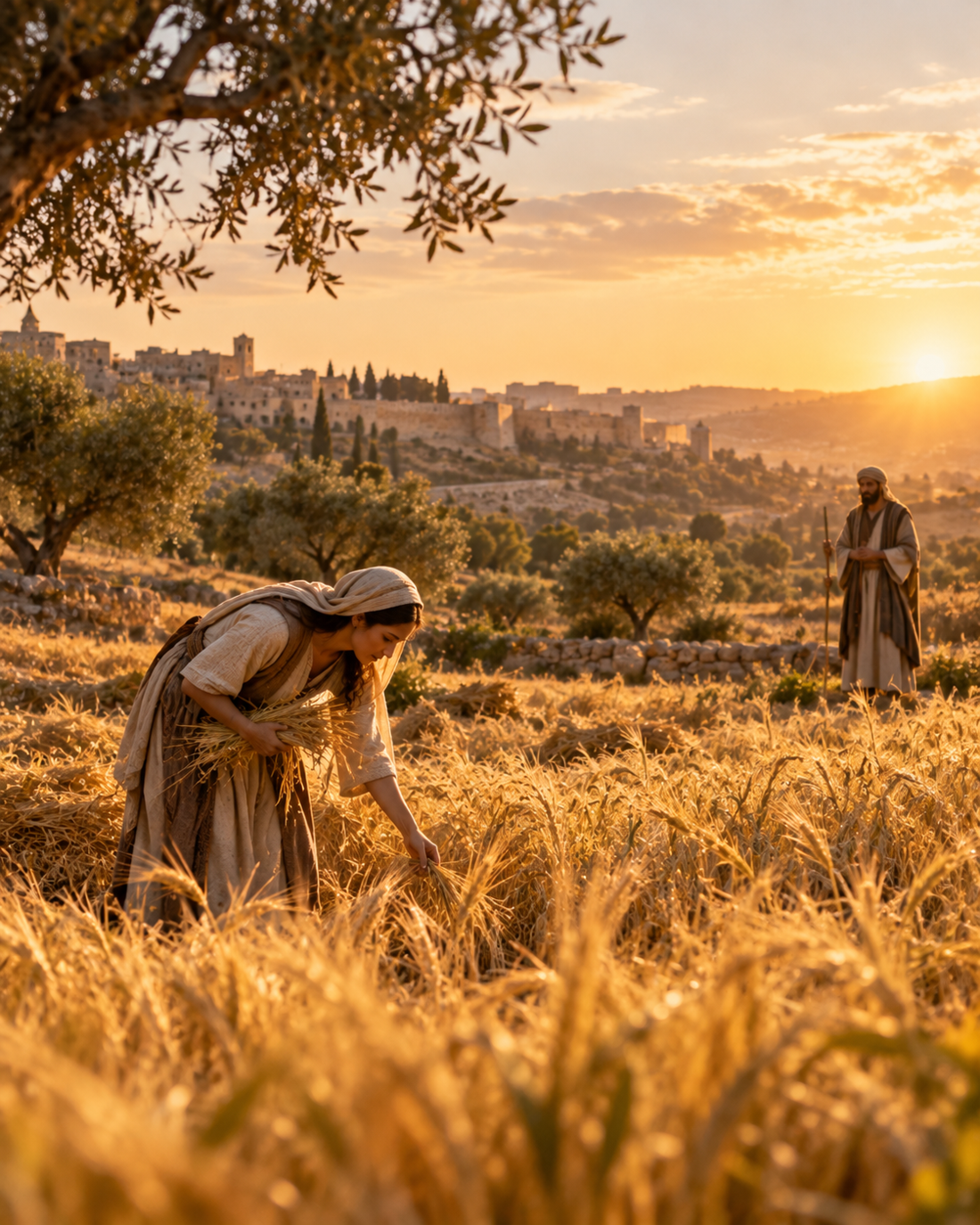
Artistic representation of Ruth gathering barley in a field at dusk, with Boaz in the background
Ruth and Boaz: the same word, chayil, for both of them.
Luke 8:1–3 · New Testament

When Jesus was supported by women

The New Testament continues this thread. Luke records a detail that we often pass over too quickly:

Luke 8:1–3 · NIV

"The Twelve were with him, and also some women who had been cured of evil spirits and diseases: Mary (called Magdalene) […]; Joanna the wife of Chuza, the manager of Herod's household; Susanna; and many others. These women were helping to support them out of their own means."

Condensed quotation: omitted passages are marked with […].

The ministry of Jesus was supported, in part, by women. The Son of God himself accepted being provided for by them.

And they were not the only ones. Lydia, a dealer in purple cloth, opened her home, and there the first church in Europe was born (Acts 16:14-15, 40). Priscilla worked with Aquila making tents and, together, they explained the way of God to Apollos (Acts 18:2-3, 26). Phoebe is called by Paul a deacon of the church, and someone who "has been the benefactor of many people", including Paul himself (Romans 16:1-2).

The Bible never rebukes a woman for working, managing resources or supporting the household.

And the verse most often quoted to say that "the man must provide"? It is 1 Timothy 5:8: "Anyone who does not provide for their relatives, and especially for their own household, has denied the faith and is worse than an unbeliever". But the context is the care of widows by their own family. In Greek, the subject is "anyone", and a few verses later Paul applies the same duty to a woman: "If any woman who is a believer has widows in her care, she should continue to help them" (1 Timothy 5:16). The text speaks of family responsibility, not of a role exclusive to the man.

Our story · Ephesians 5

"Call me and I'll change the diapers"

I have always worked. I wanted to build a career, because I wanted, and still want, to fulfill many dreams. Some I have already fulfilled; others, I know, are still to come. And the most beautiful thing in this story is that I found someone who thinks the same way. We discovered early on that building together makes the journey much lighter than walking alone.

There were seasons of withdrawal, like when Filipe was a baby. And even then Caio was always present. In the early hours of the morning, when our little one wanted to nurse, only I could do it. He would get up with me and say: "call me and I'll change the diapers". And so we went, each one helping the other.

I nursed.
He changed the diaper.
Neither of us was fulfilling a role. Both of us were fulfilling a mission.

The curious thing is that I don't remember those nights as a burden. There was joy, not weight, in it. Everything felt lighter.

Years later, Caio went through a job transition and spent some time without a steady job. That did not stop him from being a father. He dedicated himself to being closer to Filipe, taking him to swimming lessons, being with him. And that did not make him any less of a man. Then he went to do an MBA, and I stayed with our son. Then it was my turn, and he stayed. We have always supported each other, with joy in seeing what the other was accomplishing.

Perhaps you are asking: what about Ephesians 5? It is an important text, and I want to treat it with respect. It begins like this: "Submit to one another out of reverence for Christ" (Ephesians 5:21). It is from this mutual submission that Paul speaks to wives and husbands. And to the husband he asks something enormous: to love "just as Christ loved the church and gave himself up for her" (v. 25). Right after that, he explains that no one ever hated their own body, "but they feed and care for their body, just as Christ does the church" (v. 29).

The Greek verb translated as "care for" (thalpō) carries the image of warming, of holding close in warmth. Paul uses the same word in 1 Thessalonians 2:7 to describe a mother caring for her little children. Of the husband, the Bible asks for a care spoken in the language of a mother's embrace.

Care is a masculine calling too.
Provision

Providing is not a fixed role by gender. It is what each one does for the other according to the season of life.

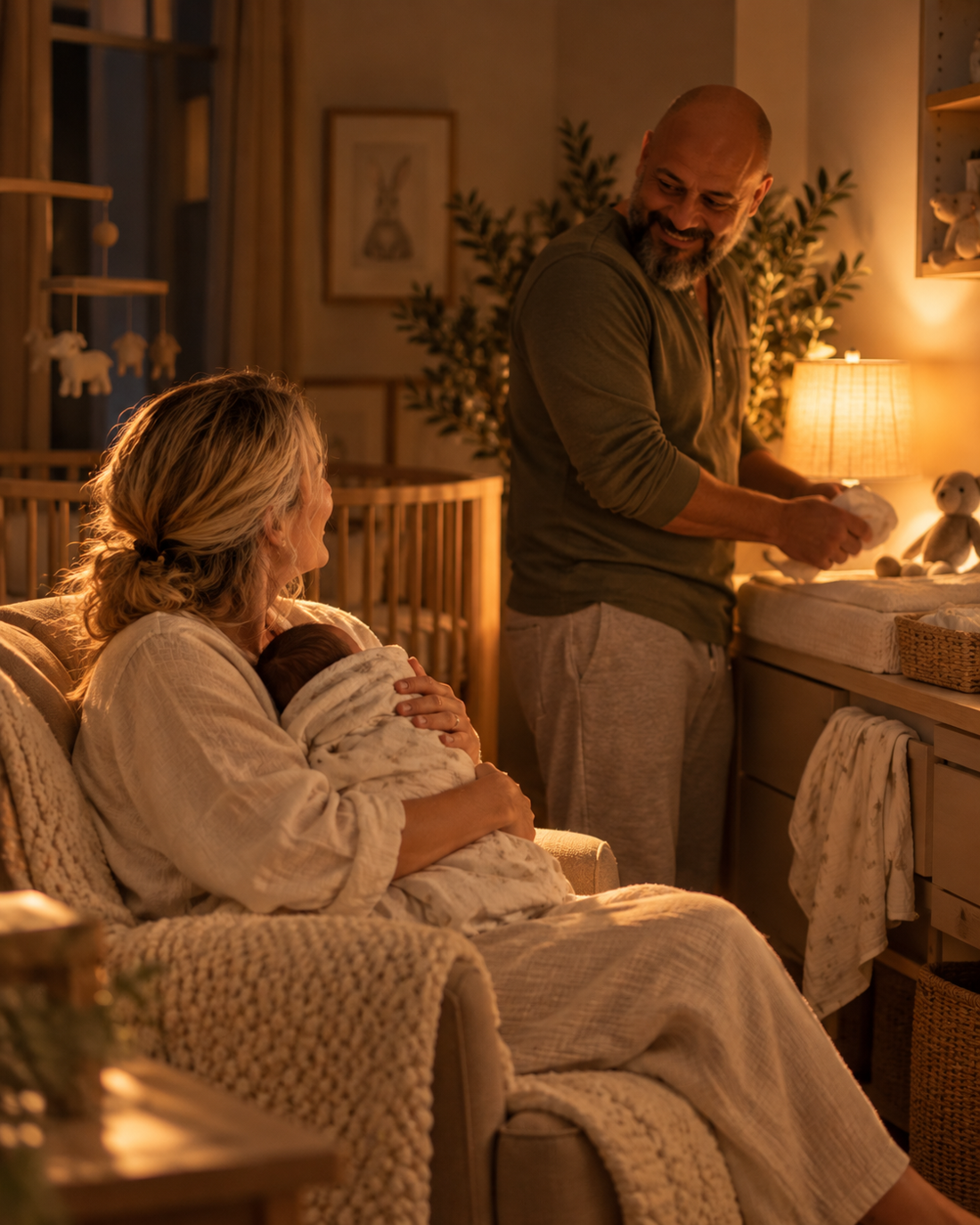
A nursery at night: the mother holds the baby in an armchair while the father prepares a diaper change
Nights shared by two: there was joy, not weight, in it.
Adoption · Ecclesiastes 4

When we didn't walk so closely together

Then came the dream of having more children, and we decided to follow the path of adoption. We were already older, Filipe was already a teenager, and two little girls arrived, Monica and Ana Beatriz, with different stories and experiences. We had the privilege of being chosen to be their parents.

Their story belongs to them. One day, if they wish, they themselves will share it. After all, no story of children who come through adoption is a fairy tale.

What I can tell is our part: this story turned us inside out. We saw, inside our own home, the power that environment and love have to transform lives. Today Filipe studies Mechatronics Engineering in Australia, and Monica, who is 9, and Ana Beatriz, who is 8, fill our home with life.

Collectible-figure style illustration of the Abondanza family: Priscila, Caio, Filipe, Monica and Ana Beatriz
This is our family the way it appears here: with lightness, and keeping our girls' faces private.

But it was not just a romantic story. There were enormous challenges. There were moments when we thought we would not make it. And, stopping to think about it, I realize something that marked me deeply: the moments when we thought we would not make it were born exactly when we were not walking so closely together.

The Bible describes this so simply:

Ecclesiastes 4:9–10, 12 · NIV

"Two are better than one, because they have a good return for their labor: If either of them falls down, one can help the other up. […] A cord of three strands is not quickly broken."

Condensed quotation: omitted passages are marked with […].

Two are better than one. But the cord that does not break has three strands.
A cord of three strands in cream and gold tones braided on linen, beside an olive branch
Two strands woven together, and a third that holds them both.
1 Peter 3:7 · Romans 8

The body that groans: perimenopause and the "not yet"

When I reached perimenopause, my life turned upside down. The powerful woman I knew seemed broken, as if she had stopped working. Sleep, energy, memory, emotions. Things I used to master seemed to slip through my fingers.

And, once again, I could and can count on Caio. He cheers for me. He looks for things that might help me. He supported my decision to change careers, and today I have my own consultancy and serve on boards. He believes in me, many times, more than I believe in myself.

This season taught me something about ezer that I had not understood before. The one who was created to help also needs to be helped. The help of Eden runs both ways. In the seasons when the woman is more vulnerable, the husband is called to be ezer for her.

Peter wrote something very beautiful about this:

1 Peter 3:7 · NIV

"Husbands, in the same way be considerate as you live with your wives, and treat them with respect as the weaker partner and as heirs with you of the gracious gift of life."

Fragility here is not a reason for diminishment. It is a reason for honor. And both are co-heirs: no one inherits more than the other.

I also need to say this clearly: what the body goes through in these seasons is not spiritual weakness. Pregnancy, the postpartum period, illness, perimenopause and menopause call for medical care, support and real adjustments in the rhythm of the home, not guilt. Faith does not replace that care; it sustains us while we take care.

And the Bible is honest about this. Paul says that "the whole creation has been groaning as in the pains of childbirth right up to the present time", and that we ourselves groan, "as we wait eagerly for our adoption to sonship, the redemption of our bodies" (Romans 8:22-23). I confess I was moved to read the word adoption in that text. The redemption of the body is still to come. For now, God's power "is made perfect in weakness" (2 Corinthians 12:9).

A mature woman holding a cup of tea by a rainy window, with her husband's hand resting on her shoulder
The one who was created to help also needs to be helped.
The new creation

The way back to Eden is forward

For a long time, I thought of redemption as a return to Eden, to the moment before the fall. But the Bible points to something even greater. It begins in a garden and ends in a garden-city, with the river of life and the tree whose leaves are "for the healing of the nations" (Revelation 22:2).

In Christ, this new creation has already begun: "if anyone is in Christ, the new creation has come" (2 Corinthians 5:17). And Paul states that, in Him, "there is neither Jew nor Gentile, neither slave nor free, nor is there male and female, for you are all one in Christ Jesus" (Galatians 3:28). In Greek, he uses exactly the words of the Greek version of Genesis 1:27, "male and female". It is a deliberate echo of creation: in Christ, the struggle that the fall brought loses its power to define anyone's worth before God.

We live in the "already and not yet". We have already been reconciled with God. We do not yet have redeemed bodies or perfect relationships. But we can live, right now, as a small sign of what is to come.

In practice, how do we recover something of what was lost in Eden?

  1. Start with the mission, not the tasks. Before "who does what?", ask: "what is our mission in this season?".
  2. Share responsibilities by gifts, energy and season of life, not by gender. There are seasons when he provides more, others when she provides more.
  3. Be ezer for each other. Help runs both ways.
  4. Bring the care of the home and the children to both of you. Caring is love, not one person's job.
  5. Honor the body in every season. Vulnerability calls for adjustment, not guilt.
  6. If you are not married, the mission is yours too. The mission of Genesis 1 does not depend on marriage. The community of faith is called to be help, as it was with the widows and as Tabitha was with the clothes she sewed (Acts 9:36-39).

Caio and I have our faults and flaws. I did not find a perfect marriage. I found a partnership that looks more like Eden than like the fall: two who help each other, who switch places when the season asks for it, and who know that a third one holds them both.

Today I have my consultancy and serve on boards. Caio is an entrepreneur who runs his own companies. Filipe is on the other side of the world, and the girls are growing up at home. But this is who we are today. Tomorrow is in God's hands. We will keep fulfilling dreams until our last day here, and eternity will be an incredible adventure.

One thing I know:

when we are together, nothing can stop us. Because, beyond the two of us, God has always been and will always be with us.

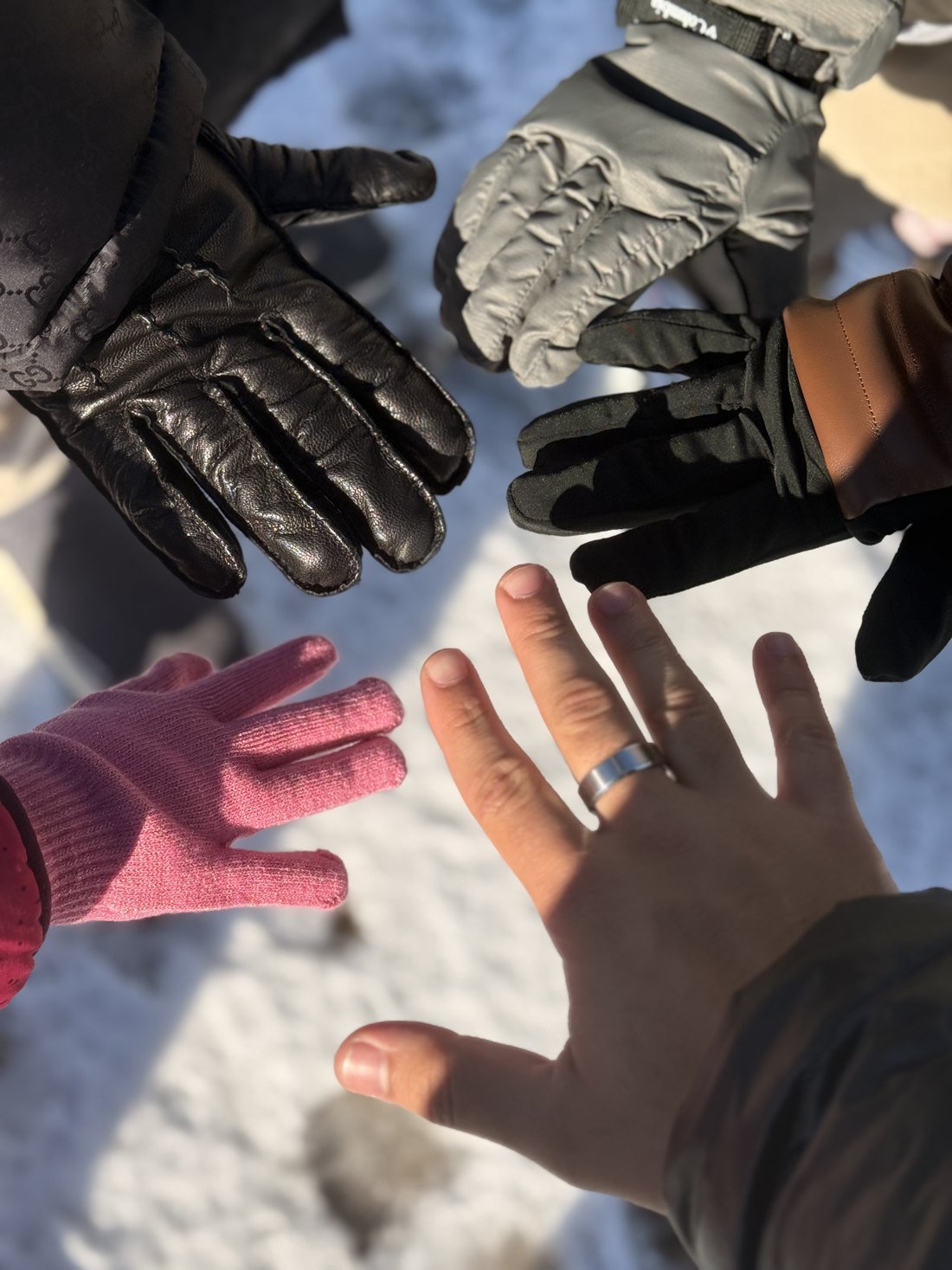
Five hands of the family, in gloves of different sizes and a wedding ring in the foreground, over the snow
The hands of our family: different sizes, one mission.
Closing

The way back to Eden is not backward. It is forward, with Christ, toward the new creation.

To carry into your week

Questions for reflection

Set aside a few minutes, if possible with a notebook nearby, and answer honestly before God. If you are married, why not talk about them together?

Before you close this page

Closing prayer

Lord, thank You that, in the beginning, You did not create us to compete, but to walk together. Heal in me the beliefs that were born from the fall and not from Your heart. Free me from the guilt that does not come from You and from the shame that You did not place on me.

Teach me to help and to be helped, to provide and to be cared for, according to the season I am living. Where my body groans, be my strength. Where we have drifted apart, bring us close again.

May my home, my life and my relationships be a small sign of the new creation that has already begun in Christ. And may You always be, beyond the two of us, the third strand that holds us together. Amen.

This study was originally written in Portuguese. In this English edition, Scripture quotations follow the wording of the New International Version (NIV); passages marked as "condensed quotation" omit parts of the verse, marked with […]. Household data: IBGE, 2022 Demographic Census. AI-generated images are artistic representations.

Continue this study

Go deeper on this journey

This content is an introduction to the complete study In Eden, God Did Not Divide Tasks. In the full material, you will find the Hebrew and Greek words explained, the historical context of each text, Proverbs 31 verse by verse, personal and couple exercises, questions for groups and a practical journey to live the mission of two in the season you are in.

I want the complete study

Fill in your details to receive the complete material of "In Eden, God Did Not Divide Tasks: He Gave a Mission to Two".

Your details will be used only to send this study and communications related to Priscila Abondanza's content.

By submitting this form, you agree to the use of your data to receive this study and related communications. Your data will never be sold or shared.

✓

All set. Your download is ready.

Download the complete study

Haven't read the first study yet? Ezer Kenegdo, the help of God